


search
date/time

Thu, 1:00PM
few clouds
8.1°C
W 3mph
few clouds
8.1°C
W 3mph
 | Sunrise | 5:35AM |
| Sunset | 6:43PM |  |

Steve Whitaker
Features Writer
@stevewhitaker1.bsky.social
P.ublished 22nd November 2025
arts
All That Is Unspoken: In A Quiet Land By Sean Body
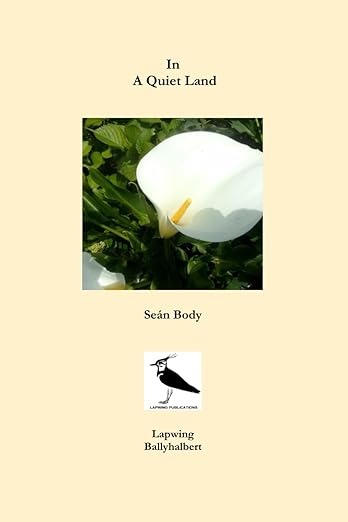
And at its heart is the brooding figure of the Catholic Church. The landscape whose temporal provenance remains undeclared throughout the anthology gives in to inference, and to Body’s own confirmation in a prefatory note to the effect that this and the other stories are set in an ‘imaginary Glenbeig, in the southwest of Ireland in the 1940s and early 50s’; more significantly, that some of the trauma visited upon Body’s characters may be drawn from personal experience. Indeed, some skilled sleight of hand signally fails to dispel the suggestion that the (in)direct indictment of the Church and its institutional cultural mechanisms emerges directly from a place of profound antipathy, the extremity of which is barely concealed behind the lyricism and achingly seductive eloquence of the author’s pen.
For there is much suffering here. The broken figure of Christina in ‘The Return’ is given, by her narrator, a belief which is also an affliction: ‘She has faith, it is ingrained, always there, part of her, as intimate and useless as a withered limb.’ That it is shared by so many makes of Body’s overview a metonym for the Church’s febrile adherence to an anachronistic dogma whose failure to console ironises the ‘intimacy’ and all-consuming nature of its social penetration. The wordless spaces – the book is filled with echoes in the interstices between thoughts – cannot stem the void of unresolved sadness with any hope, save for that which occurs like an act of mercy in the relentless infliction of pain. The character of Eoin, recently returned to Glenbeig after a lengthy absence overseas, restores parity to a narrative of displacement, broken promises and disintegrating cultural mores, by attempting to breathe new life into the brittle Christina.
Any form of resolution is rare in this collection; Body makes few concessions to comfort in stories of foundling children, unknown or displaced mothers, orphan homes and violent abuse, often supported, if not propagated, by a complicit church. And if the reader is revisiting old territory it is with an invigorated understanding of the harrowing and systemic process of erosion that undermines resistance over time. If Body’s elucidation of the process is relentless and occasionally prone to superfluity, then any criticism is mitigated in the reading, for whilst we are subdued by the weight of maltreatment and hypocrisy, the writer’s astonishingly poetic turn of phrase glimmers: in the murky depths of the Malebolge of institutionalised iniquity we find nuggets of redemptive gold that are counter-intuitive in the wider context of depravity.
Not least in the deeply affecting story, ‘Famine’, where the club-footed and ungainly figure of Sister Theresa, whose disability is the butt of juvenile humour in a children’s home, gives unexpected succour to one girl, Jenny. A paradox in a landscape of chastened good intentions, Theresa opens Jenny’s mind to the history of hardship and neglect in the rural west of Ireland during the 1840s, as she shows the bed-wetting child a love hitherto withheld from her. A purveyor of wisdom as sincerely and efficaciously as the broken bookseller Thomas Campey in Tony Harrison’s eponymous poem, Theresa confers on Jenny a sense of the past in the present and in so doing helps to secure an uncertain future:
‘She has quietly and imperceptibly, with Sister
Theresa’s subtle influence, outgrown this place. She
must retrieve the doll that has lain for so long in the
dark of her locker, seek out the one who brought it,
redeem that lost inarticulate moment’.
The wider arc of Body’s narrative resounds with the integrity of individual voices – often rendered in reflection – whose presence illuminates, if not victimhood, then a form of resistance in the act of declaration. The character of Kate in ‘In Their Own Way’, having escaped a brutal childhood and prison for minor theft, is coaxed gently into openness by the kindly Mickeen who finds a rare beauty in perceived ugliness and leads the story towards catharsis. Her own back-story is a withering tale of applied misogyny:
“The cruel burst our bubble,” she said, “show us
who we really are. As he said it, I could see my ugliness
in his face, like it was a mirror. But I could be of
service, raped me when he had a mind to. Of no
consequence, he said it was, nothing to spoil. Spat on
me like I’d soiled him.”
Body’s stories would sink without the ballast of moral authenticity. Mickeen’s love for Kate, celebrated in the purity of her singing voice, and a natural inclination to finding beauty beyond outward appearance, lends robustness to the story’s titular intention: the couple negotiate a passage through the minefield of cultural predisposition in order to transcend it.
Stylistic shifts and fluidity of tense confer some freedom on Body’s interpretation of a static landscape and its, to some degree, haunted denizens. The streams of consciousness that characterise some of the early narratives ebb and flow over the boundaries of historical memory, whilst nosing into the present, tarnishing and ironising the notion of constructive continuity. In places, Body’s thin, echoing communities resemble those of William Faulkner, like isolate voices heard in darkness. Insinuation of lines and passages of italicised text yield the ‘noises off’ of dialogue, embodying the outfall of vernacular effluent - the insult or the pejorative aside conceived in thoughtless complacency. But they cannot shift the ingrained presence of a tendency to acceptance that is entirely understandable in context, yet perverse to the alien observer. In ‘All That Is Unspoken’, a woman predicts the future for a girl of no means, commodified by circumstance and according to the world-view of men, that is both predetermined yet entertained with a sense of pragmatic inevitability:
‘“Maybe someday someone will come for her.”
“Someone?”
“Take her in, marry her maybe.” She says this as if
it is the way of life, an unbroken and unbreakable cycle,
touched only by the exigencies of fate.’
The immanent nature of belief, of its misinterpretation and dogmatic practice, compounds a broader cultural malaise whose own exigencies are disinclined towards the idea of change. Such fixtures are heavily ironised by the sometimes visceral approach of Body’s narratives: the authentic and harrowingly frank account of the detail of a hospital ward in the eponymous story brings an open-eyed and shocking certainty to the process of dying, whilst yielding a brilliant illustration of the writer’s skills. Amongst the overwhelming necrotic detritus of amputation, emasculation and ghostly decline, the narrative retains a buoyancy of hope in the figure of the nurses, whose banter, practical compassion, erudition, even, in the case of one such, relieves the sepulchrally moribund atmosphere of the ward. That the narrator is also a patient invests the narrative with the immediacy of the personal touch, conferring on mood, in his own relationship with the Milton-reading Sister Dwyer, a kind of cerebral concord whose tone is entirely extraneous to the flatulent discourse of the setting. Body is at his very best in counterpoint, drawing the sting from the tail of diagnosis and prognosis, and fashioning, like Vladimir and Estragon, raddled hope in the dialogue of a moment. The narrator, on declaring that he could easily fall for Sister Dwyer, is warmed by her response:
‘“You could, could you?” she throws back
affectionately, “you’re standing and waiting
remember.”
“For Godot.”
She considers this for a moment, laying me back
gently on the softly stacked pillows. “We’re a bleaker
race than Milton’s Godfearers,” she gives a little-girl
chuckle, “but sure if He did show up, likely He’d be a
great disappointment to us.”
“As He was to those of His time.”
“Likely we’d fare no better.”
“Do you believe, Sister?”
“Some of it,” she answers too quickly, evasively.’