


search
date/time

Sat, 7:00AM
broken clouds
12.1°C
W 12mph
broken clouds
12.1°C
W 12mph
 | Sunrise | 5:20AM |
| Sunset | 6:50PM |  |

Ruby Boyd
Politics Correspondent
P.ublished 14th February 2026
frontpage
The Peter Mandelson Principle
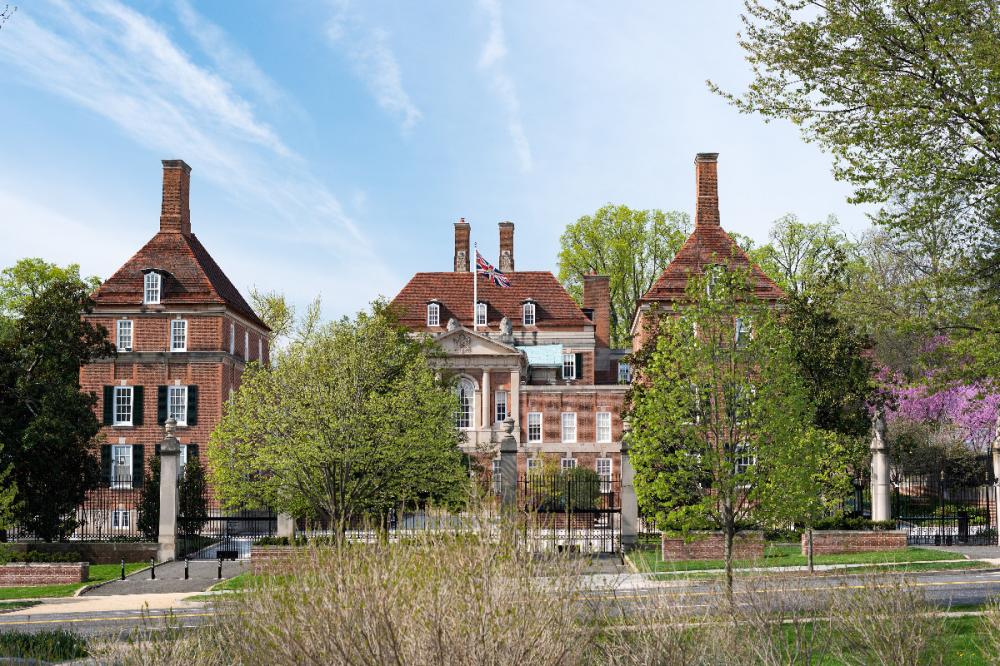
The British Ambassador's residence in Washington. Photo by RLBolton
Mandelson began his career in the Labour party in the mid 1980’s, widely regarded as one of the architects of New Labour and a key advisor to Tony Blair, contributing massively to the party victories in 1997 and 2001. He served in cabinet under Blair and Gordon Brown in various positions and was later elevated to the House of Lords as a life peer in 2008, despite his scandals in previous years.
Think of his progress through the ranks as a more sophisticated version of the old management favourite, The Peter Principle, where an employee is constantly promoted until he/she reach their level of incompetence. In the Peter Mandelson Principle, each promotion is triggered by a scandal. It's bonkers, of course, but it worked for him.
Considering his long and successful career as a politician, lobbyist and diplomat, is it disturbing to discover the sheer number of scandals he was associated with. In 1996 Mandelson failed to declare an interest free loan for a second home of £373,000 from Geoffrey Robinson to which he eventually had to resign a couple of years later. Again in 2001 he was forced to resign after accusations that he was exploiting his position of power to influence a passport application for S. P. Hinduja and yet again in 2009 after an expenses scandal showed Mandelson publicly defending his decision to bill the taxpayer over £3,000 for work on his constituency home at the same time as he stepped down as an MP. With a track record like this, it is shocking that Mandelson has consistently been allowed to work for the government and better yet, work closely with the PM.
Mandelson has recently come under fire for his close relationship with Epstein and experienced huge media coverage when the true nature of their relationship was revealed. As we know, he was recently dismissed as British Ambassador to the United States, thereby loosing a rather nice Lutchen's designed Ambassador's residence in Washington DC.
Further revelations showed that both Peter Mandelson and his husband received payments from Epstein in 2009 and 2010. The 2019 Epstein files showed payments of up to £55,000 were made to the couple between 2003 and 2004.
Peter Mandelson has since resigned from the Labour Party and the House of Lords, losing his lifetime peer position and the Met Police have commenced a criminal investigation of alleged misconduct in a public office.
A history of personal scandals and continuing connections to horrific people in higher places have revealed Mandelson's character. Not for nothing was he known as 'The Price of Darkness'. However, much of his character was known before his appointment as Ambassador to the USA, which begs the blindly obvious question: why was he allowed to continue his career in Politics?
Knock-on questions surrounding Starmer’s ability to conduct a decent and honourable government have inevitably followed and a few members of the public, and the wider political establishment, have called for his resignation.
Keir Starmer publicly apologised not only to the victims for employing someone so closely connected to a known criminal but also the public as a whole for allowing Mandelson to continue in such a powerful role in his party.
And what was the reason for the apology? A simple explanation might be that it was to save face or perhaps to limit the backlash? Or was the apology a genuine expression of remorse? We'll probably find out in 20 years when Keir Starmer publishes his memoirs.
The Prime Minister and the Labour Party have faced a serious and fully warranted backlash for this mistake. It takes little more than a casual look through the ex-ambassador's CV to see a pattern emerging. It seems that his inability to abide by the rules and a greed for money and power coupled with a narrow definition of the truth has left him with nothing but a broken reputation and jobless.
And where has this left the Labour party? Do we think there is redemption on the horizon? Or is this exactly what Nigel Farage needed for Reform to fast-track to the top?
Also by Ruby Boyd...
Andy Burnham’s First MonthBurnham Plans To Re-Form LabourIs Donald Trump A Psychopath? Some Of His Friends Think He IsStarmer On IranThe Wicked Windsor Walks (For Now)The shortened address for this article is: newspub.uk/31yc0
Search Results