


search
date/time

Sat, 7:00AM
overcast clouds
12.3°C
W 12mph
overcast clouds
12.3°C
W 12mph
 | Sunrise | 5:20AM |
| Sunset | 6:50PM |  |

Andrew Palmer
Group Editor
P.ublished 5th September 2026
arts
Review
Brighton '84, A Devastating Hour In Room 102
Philip Stokes's gripping study of class, privilege and political belief finds its power in two extraordinary performances

(L-R) Jack Stokes and Lee Bainbridge in Brighton '84
We are inside Room 102 of the Grand Hotel, Brighton, on the night before history intervenes, though nobody in the room says so outright. Barry Gleadhill, a nervy, overweight Tory who has spent the evening working up the courage to invite a much younger man back to his room, has already picked his companion earlier downstairs; now he can't stop checking that nobody saw them come in. The younger man, Johnny, is 19, public-school-educated and a socialist, which ought to make him the last person Barry would want anywhere near him. It doesn't. That's rather the point.
What follows is funnier than any description of a closeted Tory and a teenage socialist locked in a hotel room has any right to be. Stokes has a gift for the joke that lands twice — once as a laugh, once as a wince a beat later. Barry's fumbling attempt to establish whether Johnny is bisexual ("you have to make your mind up, don't you") gets one of the biggest laughs of the night; asking the 19-year-old whether he has HMV, entirely missing the HIV he means, gets the next, and somewhere underneath the laughter is the actual, era-defining terror the joke is built from. The audience was in stitches early on, and Stokes never lets the comedy soften the sting of the commentary underneath it.
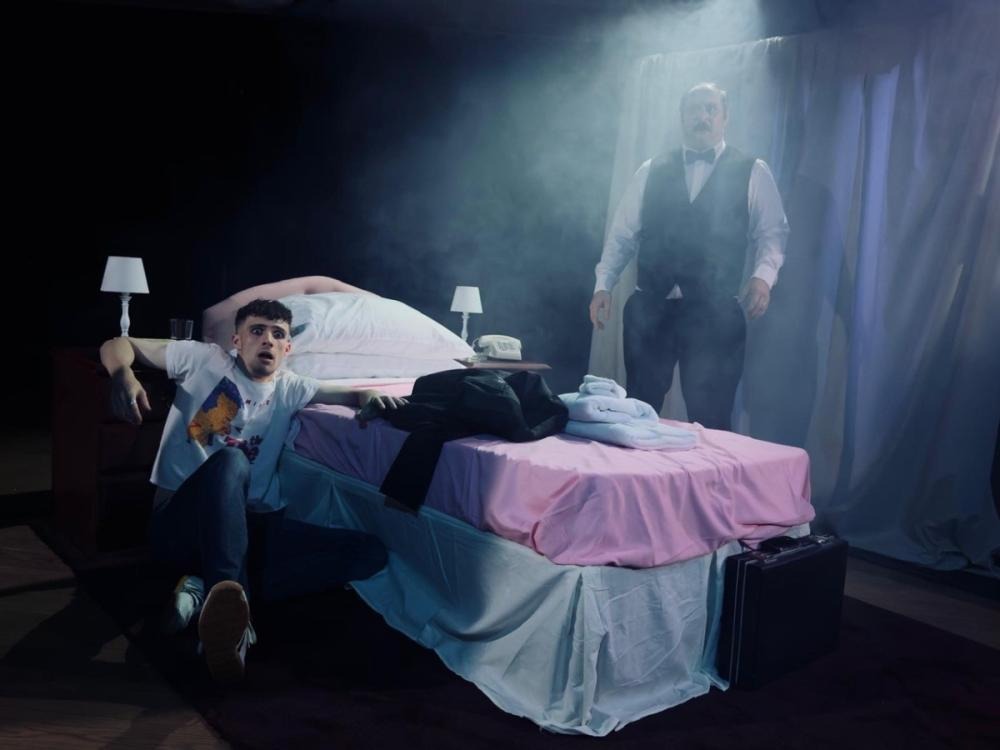
(L-R)Jack Stokes and Lee Bainbridge in Brighton '84
Because Brighton '84 is not really about a hotel-room seduction that may or may not be a transaction. It is about what both men are carrying into that room: Barry's wife, Elsie, who left him, and a son, Mark, who died — and whom, we come to understand, he sees something of in Johnny's face. Whether he can forgive what Johnny eventually confesses is the question the play spends its final act refusing to answer easily. It is a properly poignant piece of writing, the kind that earns its silences.
And then, of course, there is the small matter of what actually happened in Brighton in the small hours of 12 October 1984. Stokes doesn't need to labour the point — the date has already done the work for him — but when the explosion finally comes, the tension in the room detonates with it. It's a bold structural gamble, hanging a two-hander on a piece of national history the audience already knows the shape of, and it pays off precisely because the play has spent the previous hour making you care about two men history was never going to ask about.
A small, unplanned footnote: Harrogate Theatre's foyer currently sits behind scaffolding, nothing to do with the production, but it lent the whole evening an unintended air of things half-built and half-ruined before you'd even reached your seat. Stokes's script didn't need the help, but I'll take the omen.
This is, as billed, a play about how a tragedy changed both the people caught up in it and the political and societal landscape around them — and for once the billing undersells it. Stokes's eye for the absurdities of 1984 is sharp enough that you'll laugh before you notice he's also describing now. Nobody leaving Harrogate Theatre, I suspect, was hankering for a return to that particular yesteryear — but plenty will still be thinking about Room 102 long after they've left it behind.
Also by Andrew Palmer...
Classical Music: Mahler's Symphony No. 3 in D minorClassical Music: Beethoven String Quartets Vol 3Classical Music: Janáček The Excursions Of Mr BroučekClassical Music: Elena Ruehr: Violin Concerto No. 1Forty Years On, Mark Thomas Still Hasn't Got A PensionThe shortened address for this article is: newspub.uk/320u5
Search Results