


search
date/time

Sun, 12:00AM
clear sky
1.1°C
S 14mph
clear sky
1.1°C
S 14mph
 | Sunrise | 7:31AM |
| Sunset | 5:09PM |  |

Andrew Palmer
Group Editor
P.ublished 14th February 2026
arts
Review
Classical Music Alfvén and Rautavaara Orchestral Works
Nordic Light and Arctic Voices
Hugo Alfvén Festspel, Op. 25; Gustav II Adolf Suite, Op. 49
Einojuhani Rautavaara Cantus arcticus, Op. 61
Gothenburg Symphony Orchestra Neeme Järvi
Sara Trobäck concertmaster
Chandos Records CHSA 5386
chandos.net
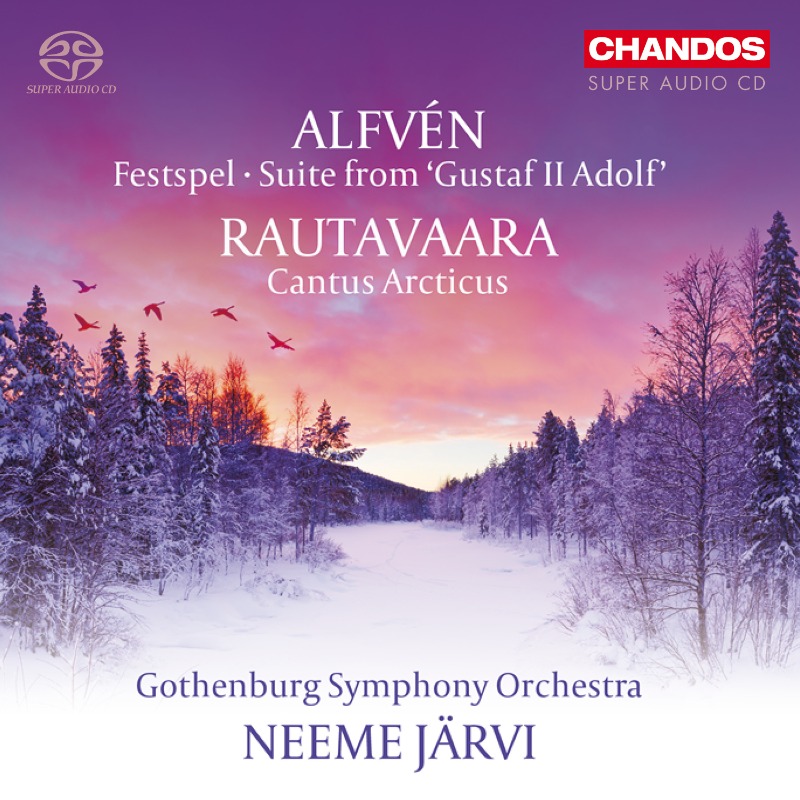
Hugo Alfvén, an accomplished composer, painter, and writer, absorbed Wagner and Strauss during his studies in Berlin, Dresden, Paris, and Brussels, yet never lost touch with the folk music of his homeland. His Festspel, commissioned for the 1908 inauguration of Stockholm's art nouveau Royal Dramatic Theatre, bursts forth under Neeme Järvi with all the confidence of a new century. Opening fanfares blaze with ceremonial splendour before yielding a glittering polonaise that wears its Tchaikovskian elegance lightly. The Gothenburg Symphony sounds genuinely exhilarated.
The centrepiece proves revelatory. The University of Oulu commissioned Einojuhani Rautavaara's Cantus arcticus, subtitled Concerto for Birds and Orchestra, for its first doctoral graduation ceremony in 1972. Rather than producing academic pomp, Rautavaara turned to the Arctic wilderness itself, weaving two-channel tape recordings of birdsong into the orchestral fabric. 'Think of autumn and of Tchaikovsky,' he inscribed at the head of the score, and that melancholy runs through the work like a vein of precious metal.
In 'The Bog', flute arabesques intertwine with the recorded cries of wild cranes from Liminka Bay. The orchestra responds in kind, creating textures that shimmer like heat haze over water. Towards the end of the movement, the strings conjure entire landscapes. 'Melancholy' transports us to windswept shorelines where larks ride the thermals; a luminous string chorale swells and recedes like breathing. The finale, 'Swans Migrating', sees the flute arabesque return as Rautavaara deploys his forces with consummate skill – textural harmonies building to a single tam-tam stroke, then diminishing to silence as the swans vanish into the distance. This is music of genuine distinction that deserves far wider currency.
Alfvén's suite from Gustav II Adolf, originally incidental music for Ludvig Nordström's 1932 play commemorating the Protestant king's death at Lützen, proves substantial in its own right. The Lutheran hymn 'Ein' feste Burg ist unser Gott' underpins the opening 'Vision', whilst the Sarabande nods to Grieg's Holberg Suite. Throughout, one catches echoes of Strauss, Sibelius, and even Elgar, yet the voice remains distinctly Swedish. The Elegy finds woodwind and strings in particularly expressive communion, whilst the finale unleashes the brass section in a pulsating march that builds to almost cinematic grandeur.